ScreenWell: Using a Digital Texting Tool to Connect Teens in the Emergency Department to PrEP Resources and Services
Statement of Problem
Adolescents and young adults comprise a significant proportion of new HIV diagnoses in the United States but are less likely than other age groups to know their status or be virally suppressed. Although the Centers for Disease Control and Prevention (CDC) recommends HIV screening and pre-exposure prophylaxis (PrEP) counseling as part of routine medical care for all adolescents, adolescents and young adults do not receive adequate HIV testing or PrEP education, and their uptake of PrEP is low.
Many barriers prevent adolescents and young adults from receiving HIV prevention and treatment services, including the lack of a medical home for primary care. It is common for adolescents and young adults to utilize the emergency department and urgent care services to meet their health care needs instead of regularly visiting a primary care provider.
Description
To meet youth where they seek medical attention while addressing the urgent need for increased HIV prevention and treatment services, two multi-site studies are implementing HIV screening programs in pediatric emergency departments: (1) ScreenSmart and (2) Screen2Prevent (S2P). The studies share similar protocols and project leadership, but they are conducted by different research networks at different sites. A third study, Optimizing Linkage of Youth from Emergency Department to Education and PrEP Care (ED2PrEP) focuses on PrEP education and linkage using digital health in the pediatric emergency department setting. A key intervention in all three studies is ScreenWell, a digital texting tool designed and developed by the multi-site principal investigators and the CHOP Research Information Systems Application Services team.
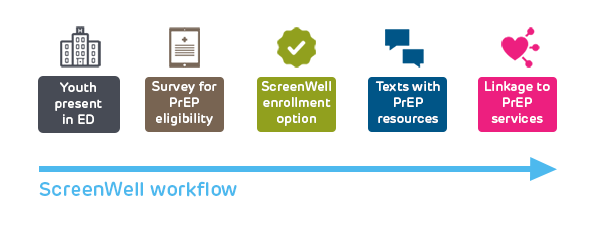
ScreenWell sends text messages with information about HIV PrEP to ScreenSmart, S2P, and ED2PrEP participants who opt in. Each study site has a health navigator who is contacted by ScreenWell when a participant decides to opt in. The navigator may then personally contact the participant and offer help with linking to clinical services.
Project Workflows
ScreenSmart and S2P
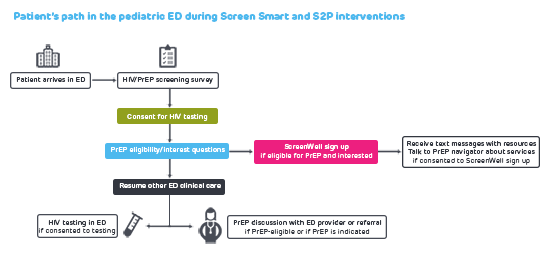
The workflow for ScreenSmart and S2P begins in the emergency department, where eligible patients take a screening survey with behavior-based questions related to HIV acquisition risk. Based on participants’ responses, the survey calculates whether they are eligible for PrEP. Individuals eligible for PrEP are asked if they would like to receive more information about the medication via text message. If so, participants may sign up for ScreenWell by providing their cell phone number and consent for receiving text messages. On the backend, ScreenWell accomplishes the following:
Engages a chat-bot to text each enrolled participant a script of messages, which include PrEP resources (trustworthy websites) and contact information for the site health navigator.
Sends a text message to the site health navigator, who reaches out to the newly enrolled participant directly to offer help.
ED2PrEP
The workflow for ED2PrEP also begins in the emergency department where patients receive regular clinical care. Patients aged 13 years and older have the option to enroll in ScreenWell using their cell phone camera to hover over a QR code. There are three distinct QR codes, each presented differently. (1) QR code #1 is posted in patient areas, and explanatory text invites patients aged 13 years and older to use their cell phone camera to scan the code for PrEP information, thus enrolling in ScreenWell. (2) Patients who undergo a sexual health evaluation as part of their ED visit care are approached by the ED2PrEP study team and asked if they would like to learn about PrEP. If so, they are invited to scan QR code #2, and the study team member guides them through the process. (3) Patients who undergo a sexual health evaluation as part of their ED visit care receive post-visit care instructions which include QR code #3.
Additional Project Information
ScreenSmart
ScreenSmart is funded by an R01 award from The Eunice Kennedy Shriver National Institute of Child Health and Human Development (NICHD) and is part of the Pediatric Emergency Care Applied Research Network (PECARN). Beginning December 2024, the study is being conducted at three pediatric emergency department sites: Children’s Hospital of Philadelphia, Nationwide Children’s Hospital, and Children’s Wisconsin – Milwaukee.
Emergency department staff are implementing universal opt-out HIV screening to patients ages 14–21 years who present in the emergency department over a period of 30 months. ScreenSmart also features clinical decision support in the electronic medical record in addition to integration with ScreenWell. These processes were first adopted and refined during a six-month implementation period meant to improve uptake of HIV screening and testing at each site.
Screen2Prevent (S2P)
S2P is supported by a cooperative agreement as part of an NICHD UM2 award to the University of South Florida for the Adolescent Medicine Trials Network for HIV/AIDS Interventions (ATN). The five S2P sites include emergency departments affiliated with Baylor College of Medicine, University of South Florida, Johns Hopkins University, St. Jude Children’s Research Hospital, and Emory Atlanta Adolescent Consortium.
Beginning June 2026, staff at these sites will implement three distinct approaches to HIV screening (universally offered opt-in, universally offered opt-out, and targeted) for patients ages 14–24 who present in the emergency department. The study will feature clinical decision support in the electronic medical record in addition to integration with ScreenWell.
ED2PrEP
Optimizing Linkage of Youth from Emergency Department to Education and PrEP Care (ED2PrEP) is a single-intervention and single-site project being conducted in collaboration with Cincinnati Children’s Hospital Medical Center (CCHMC) and funded through their Place Outcomes Research Award. The study aims to increase PrEP knowledge and uptake for HIV prevention among adolescents and young adults seen in the CCHMC emergency department by providing patients with the opportunity to engage in ScreenWell via QR code enrollment. Study activities began officially in February 2026.
ScreenWell-TreatYourSelf (TYS)
TreatYourSelf (TYS), an Android application designed to support youth in the Philadelphia area with care engagement, medication adherence, and access to reliable health information related to HIV treatment and prevention, will be retired. As such, the TYS tools will be simplified and adapted to a new digital health tool called ScreenWell-TYS. Whereas TYS is available only to Android smartphone users, ScreenWell-TYS is compatible with any phone that can receive text messages. Using text message communication, ScreenWell-TYS will offer: vetted resources related to sexual health topics, including HIV and PrEP; linkage to a health navigator for PrEP start; tips for medication adherence and care engagement; optional daily medication reminder text messages; and optional weekly text messages for information on local events and days of importance. Funding for this project is provided by the City of Philadelphia Department of Public Health.
Next Steps
Implementation for ScreenSmart, S2P, and ED2PrEP projects are in process. Development of ScreenWell-TYS wireframe and scripted chat-bot is in progress.
We hope the ScreenSmart, S2P, ED2PrEP, and ScreenWell-TYS will help adolescents and young adults receive essential testing for HIV, and for those eligible and interested in starting PrEP, will support them in getting started on the medication. Findings from the ScreenSmart, S2P, and ED2PrEP studies may provide valuable insights on overcoming barriers which that may be preventing pediatric emergency departments from adopting HIV screening programs, the benefits and drawbacks of various HIV screening strategies, and the implementation of CDC guidance related to HIV screening and PrEP counseling overall.
This project page was last updated in September 2026.
Suggested Citation
Children's Hospital of Philadelphia, PolicyLab. ScreenWell: Using a Digital Texting Tool to Connect Teens in the Emergency Department to PrEP Resources and Services [Online]. Available at: http://www.policylab.chop.edu [Accessed: plug in date accessed here].